DC CORE
Recovery designed around your workload.
Protect Windows and Linux workloads and plan how to restore them. Use Central’s backup tools yourself, or ask DC Core to operate an agreed backup and recovery service.
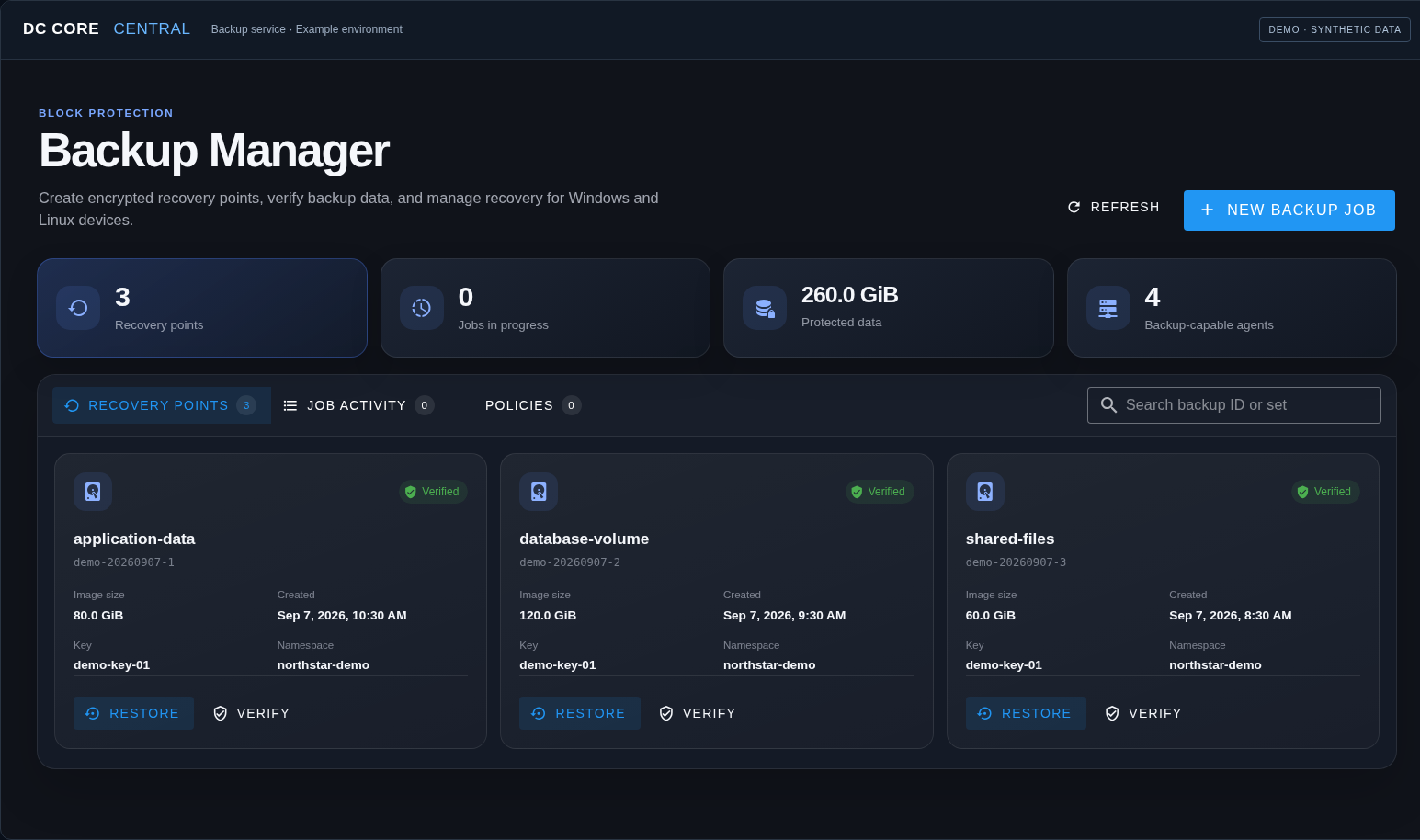
Windows and Linux backup through Central.
The agent automatically detects the preparation required, including whether a snapshot is needed. Backup management features are included in the Central subscription; backup consumption is charged separately. Managed backup checks and recovery operations are optional services.
Check agent compatibility · See licence and consumption pricing
Agree what must be recoverable.
| Decision | What we agree |
|---|---|
| Coverage | The systems, application data and dependencies included in the backup. An agent installation alone does not define a complete recovery plan. |
| Schedule and retention | Daily is the standard cycle for platform-managed systems; frequency and retention vary with the service and agreement. |
| Recovery point objective (RPO) | The target period of data loss, based on the backup or replication method and business requirement. |
| Recovery time objective (RTO) | The target restoration time, allowing for the incident, affected components and any standby capacity. |
| Restore evidence | Periodic managed backup and restoration-process checks, with customer-specific evidence where available or agreed. |
High availability and replication can help keep services running. Backup provides recovery points for deletion, corruption or failed change. Disaster recovery adds the location, dependencies and procedure needed for a wider disruption.
Protected copies and a usable recovery path.
Backups for DC Core-managed services are encrypted in transit and at rest, with restricted access. The standard managed design uses London for primary tenancy data and France for disaster recovery, within UK/EU hosting locations. External workloads follow the provider and configuration agreed for them.
Periodic restore checks validate backup availability and the restoration process. Material changes to infrastructure or applications should trigger a review of dependencies and recovery steps.
Specific recovery objectives and dedicated standby arrangements must be contractually agreed. Otherwise, restoration uses commercially reasonable endeavours. Review resilience and security details.
Confirm the data and the owner.
DC Core operates only the backup and recovery components included in the agreement. Customer application data, databases and third-party systems are protected only where they are explicitly within that scope.
Your team identifies critical workloads, acceptable downtime and data loss, retention obligations and the order services must return. We use those requirements to propose a design and agree who restores and validates each layer.
For example, restoring a database may also require working identity, network access and application configuration. We account for those dependencies when scoping managed recovery. Read the guide to isolated recovery paths.
Start with one critical workload.
Share what needs protecting, where it runs, your current backup arrangement and how long the business could be without it. We’ll identify the backup capacity, retention and managed work required, priced separately from Central licensing.